People are at the heart of every successful school.
Teachers, administrators, finance teams, support staff, and school leaders all contribute to creating an environment where students can learn and thrive. Managing this workforce effectively therefore requires more than keeping a list of employees.
Schools need structured human resource processes that support employees throughout their journey—from recruitment to retirement.
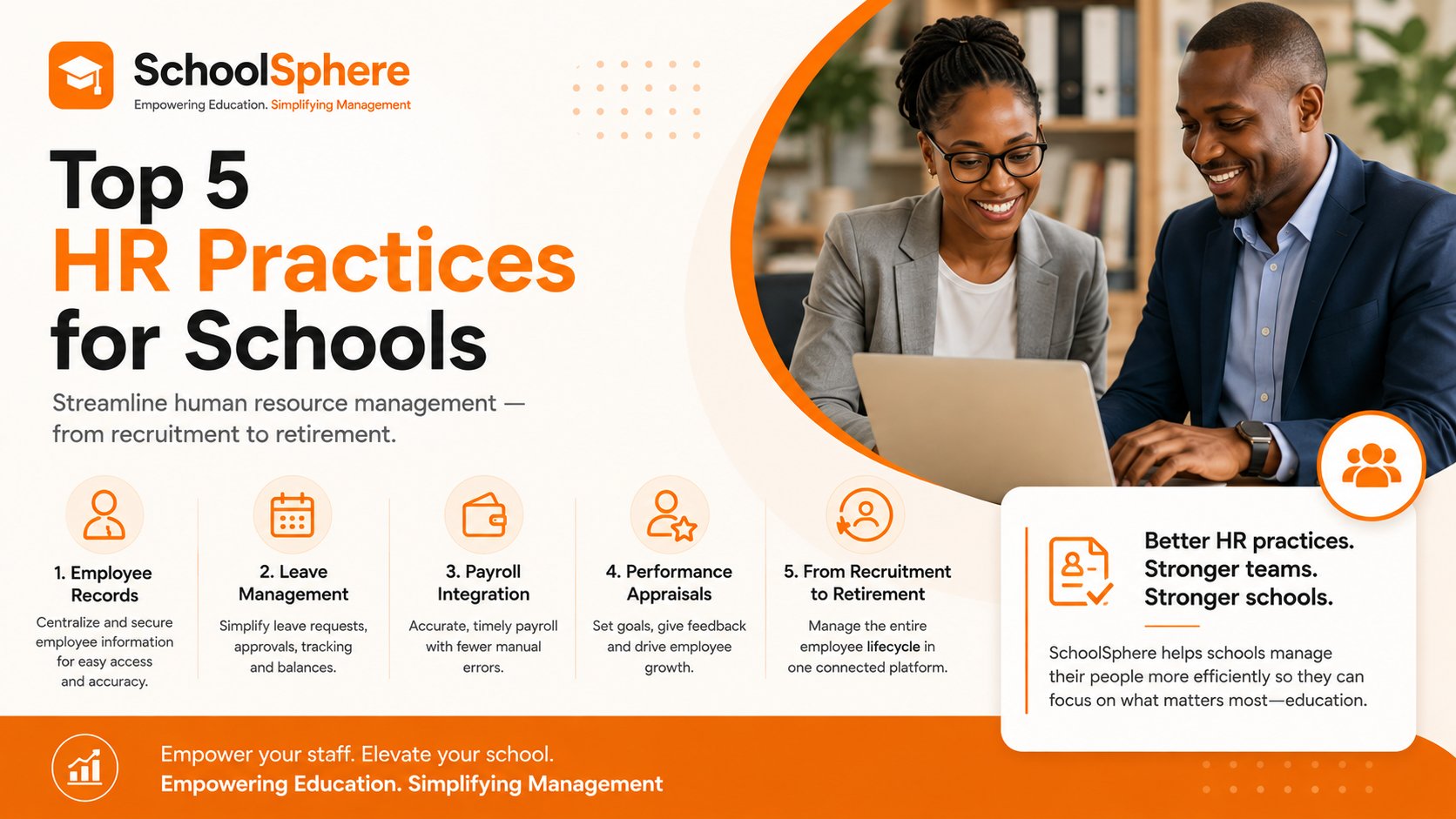
Here are five HR practices every school should consider.
1. Maintain accurate employee records
Employee records are the foundation of effective HR management.
Schools need access to accurate information about their employees, including personal details, job roles, qualifications, employment history, contracts, documents, and other relevant records.
When employee information is stored across paper files and scattered spreadsheets, retrieving and updating it becomes difficult.
A centralized digital employee record makes information easier to manage and helps schools maintain more accurate records.
It also makes it easier for authorized administrators to find the information they need when they need it.
2. Streamline leave management
Managing staff leave may seem straightforward, but it can become complicated in a busy school.
Schools need to track leave balances, requests, approvals, and dates while ensuring that staffing levels remain adequate.
A digital leave management process can simplify this workflow.
Employees can submit requests, administrators can review and approve them, and the school can maintain a clearer record of leave balances and history.
This reduces paperwork and makes the process more transparent.
3. Integrate payroll processes
Payroll is one of the most important responsibilities of a school's HR and finance teams.
Errors or delays can affect employee trust and create unnecessary administrative work.
Integrating HR information with payroll processes can help schools maintain more accurate employee information and reduce repetitive data entry.
Where payroll systems support integration, employee changes can flow more efficiently into payroll processes, helping schools improve accuracy and timeliness.
4. Make performance appraisals meaningful
Performance appraisals should be more than an annual administrative requirement.
A well-designed appraisal process gives employees an opportunity to understand expectations, receive feedback, identify development areas, and set goals.
For schools, performance management can help connect individual staff development with broader institutional objectives.
Digital performance management tools can make it easier to record appraisals, track goals, document feedback, and monitor progress over time.
The result is a more structured approach to staff development.
5. Manage the entire employee lifecycle
Good HR management starts before an employee joins the school and continues until they leave.
Recruitment, onboarding, employee records, leave, performance, payroll, professional development, promotions, and retirement or exit processes all form part of the employee lifecycle.
Managing these processes in isolation can create gaps and duplicated work.
A connected HR system provides a more complete view of each employee's journey.
Why schools should digitize HR management
Schools have unique HR requirements.
They may employ teachers across different departments, administrative staff, support teams, temporary employees, and other professionals. As the institution grows, managing all these employees manually becomes increasingly difficult.
Digital HR management helps schools:
Reduce paperwork
Improve record accuracy
Speed up routine processes
Improve transparency
Reduce repetitive administrative work
Give administrators better visibility
Create a better employee experience
How SchoolSphere can help
SchoolSphere is designed to streamline human resource management—from recruitment to retirement.
Schools can use a centralized system to manage employee records, leave management, payroll integration, and performance appraisals, creating a more connected approach to HR administration.
Instead of managing employee information across multiple spreadsheets and physical files, schools can bring important HR processes into a structured digital environment.
This allows HR and school administrators to spend less time managing paperwork and more time supporting their people.
Better HR creates stronger schools
Effective HR management isn't simply an administrative function.
When employees have clear processes, accurate records, timely payroll, accessible leave management, and meaningful performance feedback, the entire school benefits.
A well-managed workforce is better positioned to deliver the consistency, professionalism, and support that students and parents expect.
SchoolSphere — Empowering Education. Simplifying Management.