School fees collection is one of the most important financial processes in any school—and one of the easiest to make unnecessarily complicated.
From sending fee reminders and generating invoices to confirming payments and reconciling bank statements, schools can spend countless hours managing tasks that could be automated. When payments come through different channels such as M-Pesa and bank accounts, keeping accurate records becomes even more challenging.
The good news is that technology can simplify the entire process.
With the right school management system, schools can automate invoicing, integrate payment channels, and get a clearer view of fee collections in real time.
Why traditional fee collection can be challenging
Many schools still rely on a combination of spreadsheets, manual receipts, bank statements, WhatsApp messages, and paper records to manage fees.
This approach can create several challenges:
Manual invoicing: Staff have to create and send invoices for individual students or classes.
Payment reconciliation: Finance teams spend time matching M-Pesa and bank payments to individual students.
Delayed payment updates: Parents may have paid, but the school's records may not immediately reflect the payment.
Difficulty tracking outstanding balances: Identifying who owes what can require checking multiple records.
Administrative workload: Staff spend valuable time on repetitive financial tasks instead of supporting other school operations.
Limited visibility: School administrators may not have an up-to-date picture of total collections, outstanding fees, or payment trends.
These challenges become more significant as a school grows.
1. Automate fee invoicing
The first step towards streamlined fee collection is reducing manual work.
Instead of preparing invoices one student at a time, schools can use an automated system to generate invoices based on each student's fee structure.
For example, a school can configure tuition and other charges in its school management system. The system can then generate the appropriate invoice for each student, making it easier for parents to understand exactly what they need to pay.
Automated invoicing also reduces the risk of calculation and data-entry errors.
2. Make it easy for parents to pay
A good fee collection process should work with the payment methods parents already use.
In Kenya, M-Pesa is an essential part of everyday payments, while many parents and organisations also make payments directly through bank accounts.
By integrating these payment channels into the school's fee management system, schools can make payments more convenient while reducing the need for manual confirmation.
The easier it is to pay, the easier it becomes for schools to collect fees consistently.
3. Automatically match payments to students
Receiving a payment is only part of the process. The school also needs to know which student's account should be credited.
This is where payment integration can make a major difference.
Instead of finance staff manually checking M-Pesa messages or bank statements and updating student accounts, an integrated system can automatically capture payments and associate them with the relevant student invoice or account.
This significantly reduces reconciliation work and helps keep fee balances accurate.
4. Give parents clear visibility of balances
Fee collection isn't only about reminding parents to pay. It's also about giving them clear information.
Parents should be able to easily understand:
The amount invoiced
What they have already paid
Their outstanding balance
Payment history
Any applicable charges or adjustments
Clear information reduces confusion and unnecessary communication between parents and the school accounts office.
5. Automate fee reminders
Following up on unpaid fees can consume a significant amount of administrative time.
Rather than relying entirely on staff to remember which parents need to be contacted, schools can automate reminders based on invoice due dates and outstanding balances.
This creates a more consistent collection process while allowing finance teams to focus their attention on accounts that genuinely require personal follow-up.
6. Use real-time financial reporting
School administrators need more than a list of payments. They need actionable financial information.
A modern fee management system should make it easy to see metrics such as:
Total fees invoiced
Total fees collected
Outstanding balances
Collection rates
Payment activity
Student-level fee balances
With this information readily available, school management can make better decisions about budgeting, cash flow, and financial planning.
7. Choose a system that connects everything
The biggest benefit of digitising fee collection comes when the different parts of the process work together.
Instead of having one system for student records, another for invoices, separate M-Pesa records, bank statements, and spreadsheets for reconciliation, schools can bring these processes into one workflow.
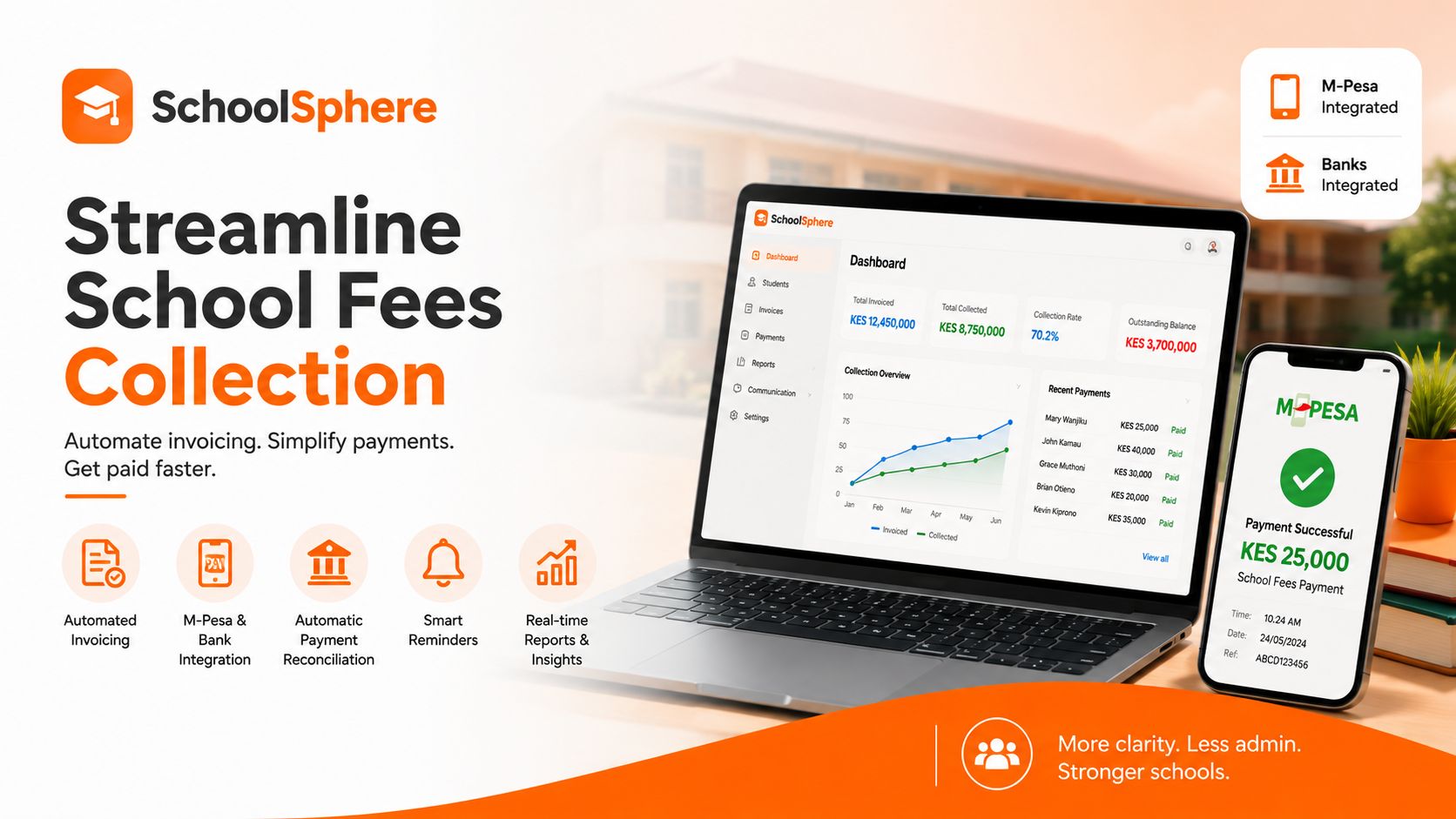
SchoolSphere helps schools streamline this process by automating fee invoicing and integrating with M-Pesa and banks.
This means schools can move from a largely manual process to a more connected workflow—from generating invoices to receiving and recording payments.
The result: less administration, better visibility
Streamlining school fees collection isn't simply about collecting money faster. It's about creating a financial process that is accurate, transparent, and easier for everyone to manage.
For school administrators, automation means less time spent on repetitive reconciliation and data entry.
For finance teams, it means clearer records and fewer manual processes.
For parents, it means convenient payment options and better visibility of their accounts.
And for school leadership, it means having a clearer picture of the school's financial position.
A smarter way to manage school fees
As schools continue to adopt digital tools, manual fee collection processes are becoming increasingly difficult to justify.
Automating invoices, connecting M-Pesa and bank payments, reconciling transactions, and providing clear fee balances can transform the way a school manages its finances.
With SchoolSphere, schools can bring these processes together in one platform and spend less time chasing payments and managing spreadsheets—and more time focusing on what matters most: running a successful school.
Ready to streamline your school's fee collection? Explore SchoolSphere and discover a simpler way to manage school finances.